
System: Super Nintendo Entertainment System
Release date: 1992
Post Contents:
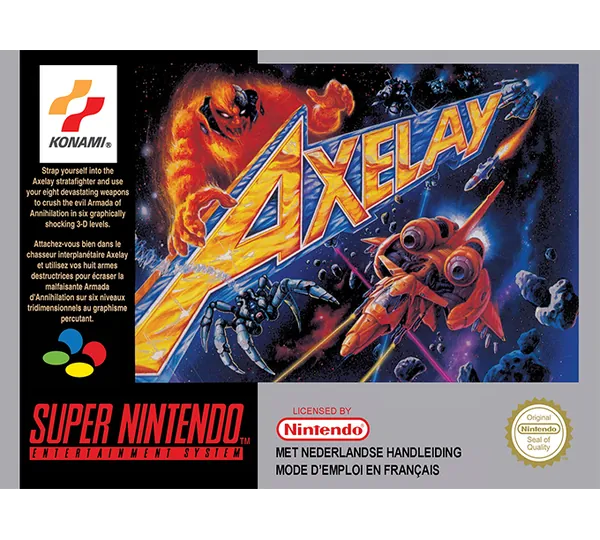
ToggleAxelay SNES is the game that asked what a shooter would look like if the stages could not decide which way up they wanted to be, and then answered it with a very pretty yes.
Konami made it in 1992, and the plot is pure space-opera shorthand: the Armada of Annihilation has swept into the Illis system, and you are the one pilot in a D117B fighter standing between them and everything else. You fly through six stages that swap between scrolling up the screen and scrolling across it, picking your guns before each run. It is quick, it is loud and it is not shy about wanting you to crash. In 2026, does Axelay SNES still fly high, or has it been shot out of the sky by time?
Gameplay: Pick, Swap, and Survive
Before every stage you load your ship with three weapons: a main gun, a special weapon and a bomb or missile, and you can swap between them as you fly. Nothing is picked up from the enemies you blow apart. Instead, every stage you clear adds a new weapon to your armoury, so the second half of the game lets you build a much nastier kit than the first, with things like a multi-way shot, a Vulcan cannon and spread bombs to choose from.
The cleverest touch is that your selected weapon doubles as your armour. Take a hit and the weapon you were using is knocked out and you are left with a feeble default gun, and a second hit destroys the ship. The stages are split between vertical levels, where you scroll up the screen over the planet below, and horizontal ones, where you slide sideways through narrow corridors, and each one ends with a boss big enough to need a few swaps of weapon before it goes down. Lose all your lives and you spend a continue, and you only get a limited number of those.
The Scenery Smash? Here is the sting: crash into a wall, a pillar or an enemy and the ship is gone instantly, with no shield and no second chance. In the horizontal stages in particular, the corridors squeeze down tight and the scenery moves just fast enough to catch you out when you are busy watching the bullets. You respawn where you died, which is kind, but you come back with a bare gun and the same wall still waiting. Learn the layouts, hug the middle and treat every narrow gap with the suspicion it deserves.
Graphics: A Planet Rolling Under You
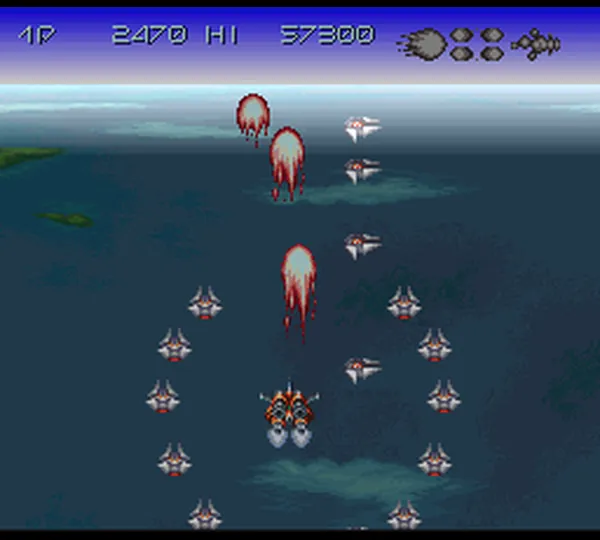
This is Konami showing off what the Super Nintendo could do. In the vertical stages the ground twists and warps under you as it scrolls, so it looks like the ship is skimming over a curved surface, and the enemies swell as they come toward you in a pseudo-3D effect. Layers of cloud and sea drift past at different speeds behind them, and the title screen opens with big chunky metallic lettering on a black starfield.
It has aged better than most of its crowd. The sprites are crisp, the bosses are huge and the colour is bold, from cloud tops and open sea to the red glow of a lava planet, and the effects still look good on a big modern telly. It can get busy when a lot of bullets and small silver fighters fill the screen at once, but the ship stays readable, which is half the battle in a shooter.
Sound: Taro Kudo’s Thundering Score
Taro Kudo wrote the soundtrack, and it is a belter. It has driving, melodic tunes that suit the swooping stages, with a real sense of rushing forward, and the boss themes ramp up the drama just when you most need it. The music was good enough that a full soundtrack album came out in Japan in the same year.
The effects are punchy and satisfying: the rattle of the Vulcan cannon, the thump of a bomb landing and the rumble of a big boss going up. Everything lands with a crunch rather than a pop, which is exactly what you want from a shooter, even if the sound of your own ship exploding is one you will hear more often than you would like.
Replayability: A Short Flight Worth Repeating
Six stages is not a long campaign, and a decent run can be over in the time it takes the kettle to boil twice. What stretches it is the weapon kit, because the armoury grows as you go, and you will want to try different mixes on stages you have already flown. Work out which main gun suits which boss and the whole thing starts to feel like a puzzle as well as a shooter.
Finish it and the game loops back to the first stage with higher difficulty and denser bullet patterns, which is a decent excuse to go round again and chase a better score. If you like short, sharp shooters that you can play in one sitting and then challenge yourself with, you will get plenty out of it. If you want a long adventure, you will be done before the second cuppa.
The Retro Looney Verdict
Axelay SNES is fast, gorgeous and cleverly built, a shooter that mixes vertical and horizontal stages, hands you a growing armoury and wraps it all in a hard-hitting soundtrack. It was a showpiece for the console, and it still plays like one.
Yes, the scenery will kill you without a second thought, and the campaign is short. None of that stops it being one of the best-looking and best-sounding shooters on the system. Load the Vulcan cannon, keep to the middle of the corridor and see the Armada off before tea.
Don’t forget to check out my other SNES Reviews!

Media