
System: Atari Lynx
Release date: 1990
Post Contents:
ToggleKlax Atari Lynx is the game that proved you can build an addiction out of a conveyor belt, a paddle and a handful of coloured tiles.
Atari Games made the arcade original, and the Lynx version arrived in autumn 1990 to put the whole thing in your pocket. Tiles tumble down a belt towards you, you catch them on a paddle and stack them in a well, and the goal is to line up three of the same colour before the mess gets out of hand. It sounds like nothing and plays like a drug. In 2026, does Klax Atari Lynx still have the knack, or has it dropped the lot?
Gameplay: Catch, Flip, and Klax
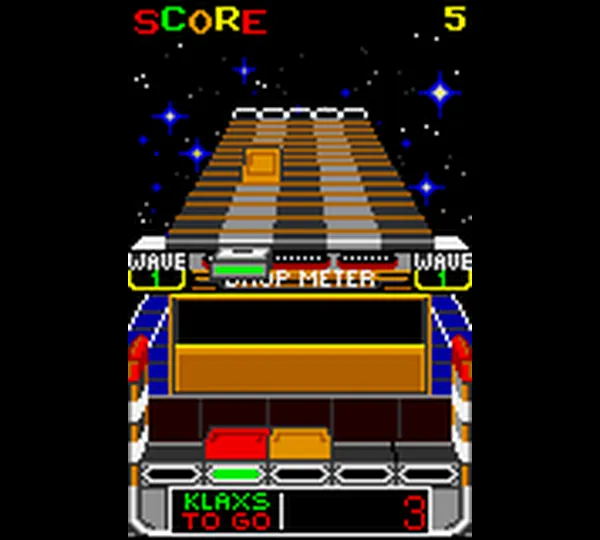
Everything is built on one neat idea. Coloured tiles roll down the conveyor belt, you slide the paddle left and right to catch them, and you can hold up to five at a time. Press the button and the top tile drops into the well below, which is a grid of 25 spaces, and the aim is to form a Klax, an unbroken line of three matching tiles, whether it runs across, up and down or diagonally.
The clever part is how much you can do with so little. Push up and you flip the top tile back up the belt, pull down and the tiles speed towards you, and the bonuses for lines of four or five, or for several Klaxes from a single tile, make you feel like a genius. There are 100 waves, each with its own goal, whether that is a number of Klaxes, a points target or surviving a set number of tiles, and after every fifth wave you get to choose from three options.
The Drop Meter? The trouble is that mistakes add up. Every tile that slips off the belt or lands on a full paddle counts as a drop, and the Drop Meter only has so much patience. Once the tiles speed up and the colours start to blur, you will be flailing at the pad and wondering why you thought this was relaxing. Take a breath, keep the well tidy, and do not panic when the first three drops go.
Graphics: Colour on a Small Screen
The Lynx’s screen was built for bright, chunky colour, and this suits it perfectly. The tiles are big, clear and easy to tell apart, the well is tidy and the conveyor belt gets its sense of depth from a smart bit of perspective. When you are trying to spot three reds in a row, clarity is everything, and the Lynx delivers.
It is hardly a technical showpiece, and there is nothing here that will make you gasp, but that is the point. The pictures are clean, the colours are strong and nothing gets in the way of the puzzle. Even now, it looks like it was designed by someone who knew exactly what the game needed.
Sound: Blips, Bleeps, and Brain Fuzz
The music and effects are brisk and bright, and they keep up a gentle sense of rising panic without ever getting in the way of your concentration.
The effects are crisp, and you get clear feedback whenever a Klax clears from the well. I would call them a good match for the game, simple, snappy and never annoying.
Replayability: One More Wave
With 100 waves, every one with a goal, there is a lot to chew on. The bonus points for tiles left on the belt and empty spaces in the well keep you trying to play a bit better each time, and the chance to choose your route after every fifth wave gives you a sense of control.
It is the perfect pick-up-and-play game for a bus ride or a queue at the post office, though it can start to feel repetitive after a long session. If you like puzzle games with a bit of tension, you will keep returning for one more wave, and then another.
The Retro Looney Verdict
Klax Atari Lynx is simple, addictive and brilliantly paced, a puzzler that makes sense in seconds and takes ages to master. The controls are crisp, the waves are well judged and the Lynx screen suits it perfectly.
Yes, the Drop Meter punishes you, and the pace can get frantic. The panic is real. None of that stops it being one of the great pocket puzzlers. Catch, stack, and keep an eye on the drops.
Don’t forget to check out my other Lynx Reviews!

Media