
System: Commodore 64
Release date: 1985
Post Contents:
ToggleUltima IV: Quest of the Avatar on the Commodore 64 is the game that looked at every other RPG, tutted quietly, and decided the real villain was your own character flaws.
This Ultima IV title binned the pantomime villain, scrapped the world-ending catastrophe, and replaced the whole familiar setup with something genuinely radical – a game that asks not whether you can defeat evil, but whether you’re actually a good person. The Eight Virtues of Britannia are your quest objectives, your compass, and your judge. You are not here to save the world. You are here to deserve it. In 2025, does this Ultima IV C64 landmark still carry that weight, or has time finally softened its moral edge?
Gameplay: Becoming the Avatar, One Decent Act at a Time
Ultima IV on the Commodore 64 opens with a personality quiz dressed up as a series of moral dilemmas. Your answers determine your starting class – each one tied to a virtue, from Honesty and Compassion through to Humility and Spirituality. From your very first steps in Britannia, the game is watching how you behave.
The world is enormous by 1985 standards – overworld exploration, towns, castles, shrines, and multi-level dungeons all connected into one seamless landmass. You build a party of up to eight companions over time, each representing a different virtue, and success depends far more on preparation, balance, and paying attention than on simply being strong enough to win fights.
Conversations use a keyword system that rewards genuine engagement. NPCs drop hints that only make sense if you’ve actually listened, and the game quietly judges you for every transaction, every combat decision, and every choice to help or ignore someone in need. Combat is turn-based and deliberately paced – positioning, spell management, and party composition matter considerably more than button mashing.
The Virtue Slip? Ultima IV on the Commodore 64 keeps score in ways it rarely bothers to announce. One carelessly nicked food item when you’re short on supplies, one lie told to the wrong NPC, one unnecessarily violent combat resolution – any of it can quietly set your virtue progress back without so much as a warning. Combined with keyboard-heavy controls that haven’t aged as gracefully as the design around them, cryptic hints that occasionally require knowledge the game never directly gives you, and a learning curve that treats hand-holding as a personal insult, it can feel genuinely punishing to newcomers. The game expects commitment and offers very little reassurance that you’re doing it right.
Graphics: Britannia Between the Lines
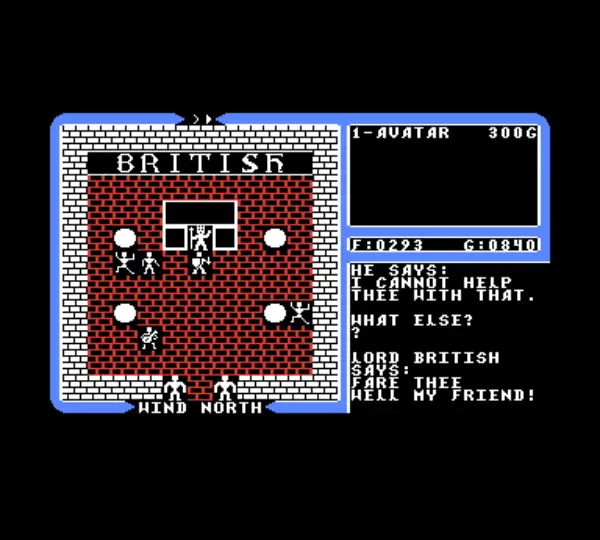
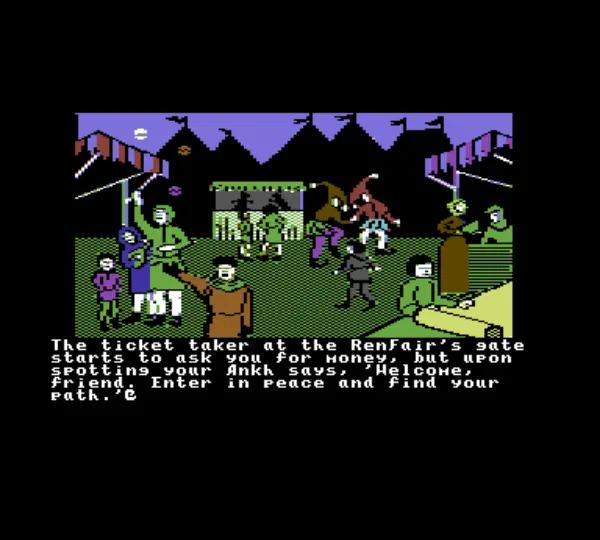
Ultima IV on the Commodore 64 is abstract by any modern measure – tile-based landscapes sketching out forests, coastlines, mountain ranges and castles in broad strokes, characters and monsters rendered small but unmistakable. First-person dungeon exploration adds welcome tension with stark corridors and very limited sightlines that make every step forward feel like a genuine decision.
It works because it was never trying to show you Britannia – it was always trying to make you imagine it. The visual restraint leaves enormous room for the world to feel bigger and more real than the pixels technically justify, and forty years later that approach holds up considerably better than more ambitious presentations that simply look dated.
Sound: Quiet Tunes with a Lot to Say
Ultima IV on the Commodore 64 takes the same restrained approach to audio that it takes to everything else – deliberate, purposeful, and not remotely interested in showing off. Town themes are gently comforting, wilderness tracks lean into isolation and scale, dungeon music keeps tension simmering without tipping into drama.
Sound effects are sparse and functional – combat cues, spell effects, movement sounds, all present and correct without ever demanding attention. The restraint suits the contemplative tone beautifully. This is a game about reflection and moral consideration, and an audio package that constantly competed for your attention would have undermined both.
Replayability: Walking the Path More Than Once
Different starting classes in Ultima IV on the Commodore 64 produce meaningfully different journeys through Britannia – a Paladin’s path to Avatarhood looks and feels quite different from a Bard’s, and the virtue you begin weakest in shapes which parts of the world demand the most from you.
Chasing moral perfection, exploring corners of Britannia ignored on a first run, or approaching the virtue system with a stricter personal code all give returning players genuine purpose. The learning curve is steep and the game offers no shortcuts, but it rewards commitment with a sense of progress and eventual accomplishment that most RPGs of the era simply couldn’t match.
The Retro Looney Verdict
Ultima IV: Quest of the Avatar on the Commodore 64 is slow, demanding, occasionally about as forgiving as a disappointed schoolteacher, and one of the most genuinely important games ever made. It changed what RPGs thought they were allowed to ask of players – not just “can you beat the bad guy” but “are you actually worth following” – and nothing was quite the same afterwards.
The interface creaks. The virtue tracking will catch you out in ways that feel deeply unfair at least once. You will need patience, a notepad, and probably more than one session before Britannia starts to make sense. This Ultima IV C64 classic rewards thoughtfulness in a way that modern games with their quest markers and waypoints rarely bother to attempt. Not a quick blast before tea. A proper sit-down with the game that quietly invented the RPG’s conscience. Bring biscuits.
Don’t forget to check out my other Commodore 64 Reviews!

Media