
Cast your mind back. You’re ten years old, huddled under the duvet with a torch and a Game Boy that’s eating through AA batteries like they’re going out of fashion.
The screen’s barely visible, your eyes are going square, and you absolutely do not care because Tetris is not going to play itself.
That feeling – that magical, slightly illegal feeling of gaming after bedtime – is back. And this time it fits in your jacket pocket, runs for eight hours on a single charge, and plays basically everything up to the PlayStation 2.
Welcome to 2026, where retro handheld gaming has quietly become one of the biggest things in the entire gaming world. And if you haven’t noticed yet, you’re about to.
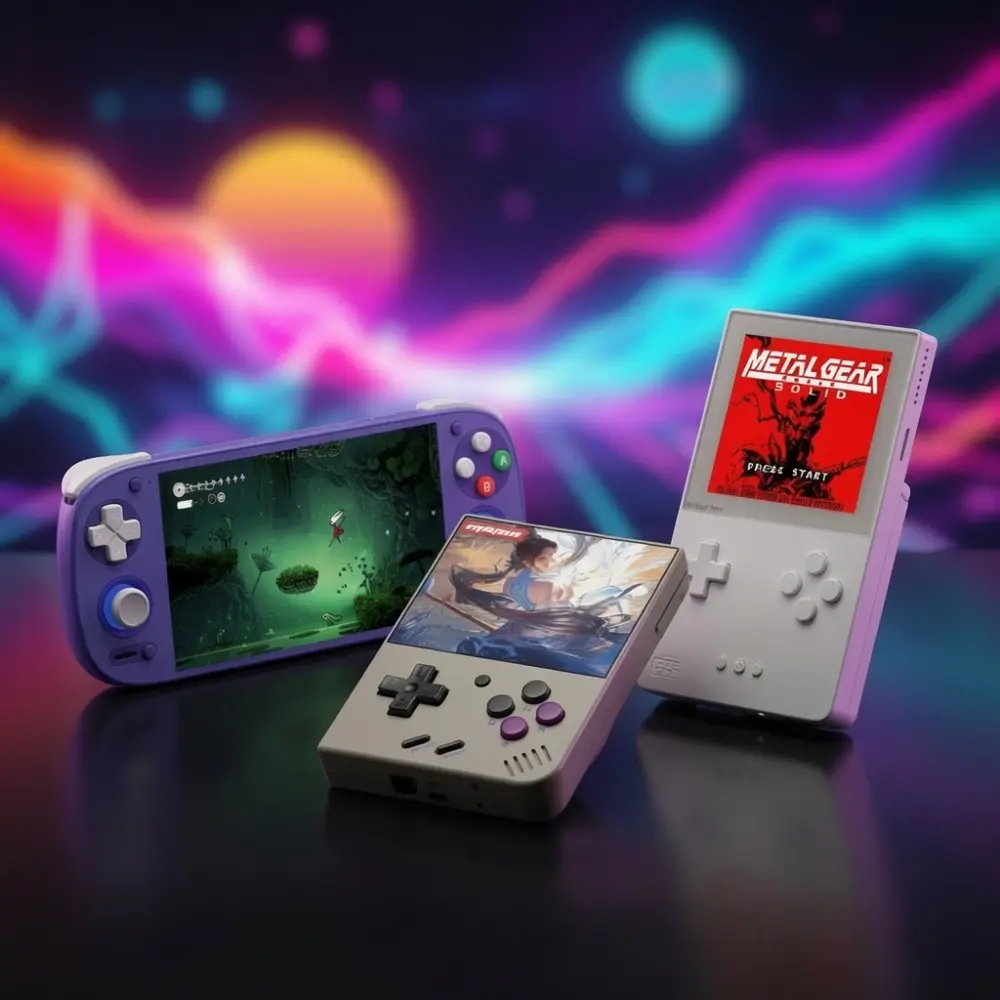
Why Is Everyone Suddenly Carrying a Tiny Retro Console?
Modern gaming, let’s be honest, has got a bit exhausting. Day one patches the size of a small country. Battle passes. Live service loops that want you to log in every single day or miss out on some limited skin you’ll never actually wear. Tutorial sequences longer than some entire retro games. Gaming used to mean picking up a controller and playing. Now it sometimes feels like a second job with worse pay.
Retro handhelds cut straight through all of that. You press power, you pick a game, and you’re in. No downloads. No updates. No microtransactions trying to nick your wallet while you’re not looking. Just you, a controller, and thirty years of absolute bangers at your fingertips.
It’s no wonder the market has absolutely exploded. The retro gaming market hit £3.8 billion in 2025 and is already past £4 billion in 2026. Handheld sales alone jumped 40% last year. This is not a niche hobby anymore – this is a proper movement.
The Big Players: What’s Actually Worth Your Money
The Analogue Pocket – The Premium Choice
If money is no object and you want the absolute gold standard, the Analogue Pocket is it. This beautiful bit of kit plays original Game Boy, Game Boy Color, and Game Boy Advance cartridges natively – your actual physical carts, not emulated copies. The screen is stunning, the build quality is exceptional, and with optional adapters it even plays Game Gear and Atari Lynx cartridges.
It’s the Ferrari of retro handhelds. Gorgeous, capable, and priced accordingly at around £180-200. But if you’ve got a cartridge collection gathering dust, this is the machine that makes it sing again.
The Miyoo Mini Plus – The Budget Hero
For around £40-50, the Miyoo Mini Plus is an absolute revelation. It handles everything up to PlayStation 1 beautifully, has a gorgeous little IPS screen, fits in any pocket, and has a thriving community constantly improving it with free custom firmware. It even looks dead cute, like someone shrunk a Game Boy and gave it a glow-up.
If you’re new to this world and just want to dip a toe in without spending a fortune, start here. You will not regret it.
The Retroid Pocket 5 – The Powerhouse
The Retroid Pocket 5 is what happens when you take the retro handheld concept and absolutely go for it. OLED screen, Android-powered, handles PlayStation 2, GameCube, Dreamcast and more without breaking a sweat. It’s the one the community keeps recommending for anyone who wants serious emulation performance without going full Steam Deck.
If you grew up on the PS2 era and want to revisit it properly, this is your machine.
The Handheld That Started It All: A Nod to the Original
None of this exists without Nintendo’s original Game Boy landing in 1989. A grey brick with a blurry green screen that ate batteries for breakfast and somehow still sold 118 million units worldwide. It proved beyond any doubt that people would carry a gaming machine in their pocket even when it was objectively inconvenient, underpowered, and occasionally impossible to see in direct sunlight.
Thirty-seven years later, the handhelds of 2026 are faster, sharper, and infinitely more capable – but they’re all chasing that same feeling Nintendo accidentally bottled in a grey plastic rectangle in 1989. Gaming on the go. Anytime, anywhere, no arguments.
Should You Buy One? The Looney Verdict
If you’ve got any fondness at all for the games of the 80s, 90s and early 2000s – yes. Absolutely yes. The barrier to entry has never been lower, the hardware has never been better, and the library of games you get access to is staggering. Every sleepover classic, every lunch break obsession, every game you swore you’d go back to someday – all of it, in your pocket, right now.
Modern gaming will still be there when you get back. Probably with another battle pass and a day one patch. It can wait.
Grab a handheld. Go find a quiet corner. Feel ten years old again. You’ve earned it.