
System: Sony PlayStation
Release date: 1995
Post Contents:
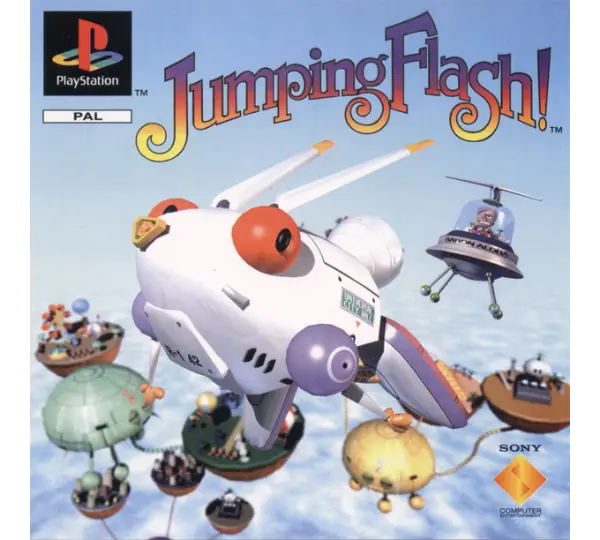
ToggleJumping Flash on the PlayStation is the game that looked at the first-person perspective, decided it wasn’t being used ambitiously enough, and gave it to a robotic rabbit who can jump three times in mid-air and look straight down at the ground below.
This Jumping Flash title arrived as a PlayStation launch title in 1995 and immediately demonstrated that the new hardware wasn’t just going to deliver better versions of existing games – it was going to enable things that hadn’t been possible before. You are Robbit, a robotic rabbit deployed by Baron Aloha to recover jet pods scattered across six surreal floating worlds before the villain makes off with them. It is as magnificently daft as it sounds and the gameplay is genuinely brilliant. In 2026, does this Jumping Flash PS1 launch curio still leap to the occasion, or has it finally come back down to earth?
Gameplay: Three Jumps Up, One Look Down
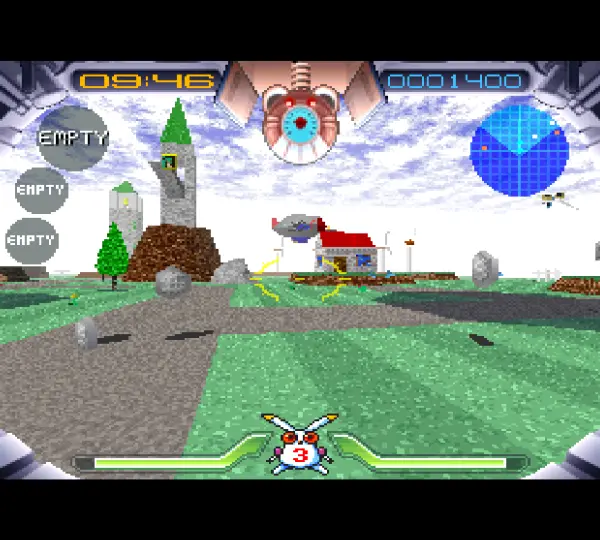
Jumping Flash is a first-person platformer – a combination of words that sounds like it shouldn’t work and works completely. Robbit navigates each floating world in first-person view, collecting jet pods scattered at various heights and altitudes while dispatching enemies with a homing weapon. The twist that makes everything click is the triple jump – Robbit can leap three times consecutively, gaining enormous height, and at the apex of each jump the view tilts downward to show you the ground far below, giving you a brief window to aim your landing.
That downward view is the game’s genius. It turns what could be a disorienting mess into something surprisingly precise and readable – you can see exactly where you’re about to land, what’s waiting for you there, and whether the pod you’re aiming for is reachable from this trajectory. The sense of height and aerial control it creates is genuinely exhilarating, and the floating world designs give the mechanics enormous room to breathe with platforms at wildly varying altitudes that reward confident, ambitious jumping.
Six worlds each containing three stages plus a boss deliver a campaign that’s short but consistently inventive, and each world has its own visual and mechanical identity that introduces new enemy types and layout ideas without ever overstaying its welcome.
The Long Drop? Jumping Flash is a short game – a confident player can see the credits in a single sitting – and while the worlds are inventive the overall content is genuinely slim. The homing weapon makes combat largely automatic, which removes much of the skill ceiling from the enemy encounters and reduces them occasionally to something closer to a distraction than a genuine challenge. Some of the later stages introduce tighter time limits that sit awkwardly with the otherwise exploratory pace, and players who don’t immediately click with the first-person platforming perspective may find the sense of spatial orientation elusive before the mechanics have had time to settle.
Graphics: Cartoon Worlds That Still Charm
The visuals are bright, colourful, and deliberately cartoon-surreal – floating islands, giant mushrooms, candy-coloured skies, and enemy designs that lean into cheerful absurdity rather than technical realism. It was a smart aesthetic choice for 1995 PlayStation hardware because it aged into something that reads as charming rather than dated, and the sense of scale the game creates – tiny Robbit against enormous floating landscapes – still impresses.
The first-person perspective keeps the technical limitations of the era largely out of view, the downward jump camera creates a genuinely effective sense of vertigo at height, and the boss encounters are large and visually entertaining. For a launch title it’s a confident and coherent visual package.
Sound: Bouncy Tunes for a Bouncy Rabbit
The soundtrack is energetic and cheerful throughout – upbeat electronic compositions that match the game’s cartoon surrealism without ever tipping into irritating. Each world has its own musical identity and the boss themes bring appropriate urgency to the larger encounters.
Sound effects are crisp and satisfying – Robbit’s triple jump produces a pleasingly escalating series of spring sounds, enemy impacts register cleanly, and the audio feedback from successful pod collection gives each pickup a small moment of satisfaction. Simple and purposeful, which is exactly right for a game where the visual experience is doing most of the heavy lifting.
Replayability: Short But Worth Revisiting
Jumping Flash is honest about its replay depth – the campaign is short and the mechanics, while brilliant, don’t generate the same long-term mastery pull as deeper games. What brings players back is the sheer fun of the triple jump system and the pleasure of navigating familiar worlds more confidently and quickly than the first time through.
Time attack and score chasing give dedicated players clear goals, and the game’s compact size makes it a natural revisit for quick sessions. The two sequels – Jumping Flash 2 and Robbit Mon Dieu – expand the formula significantly for anyone who wants more, but the original stands completely on its own as a tightly designed piece of early PlayStation magic.
The Retro Looney Verdict
Jumping Flash is one of those games that only gets more impressive the more you think about what it was doing in 1995. A first-person platformer with a triple-jumping robotic rabbit, floating cartoon worlds, and a downward camera that makes aerial navigation genuinely readable – it’s an idea that shouldn’t work, executed so confidently that it’s impossible to imagine it any other way.
Short, occasionally slight in its combat, and over before you’ve quite had enough of it. None of that changes the fact that this Jumping Flash PS1 title is a genuine PlayStation gem that understood the hardware’s potential from day one and did something genuinely original with it. Still one of the most purely joyful games on the system. Load it up, find your jet pods, and try not to look down. Actually, always look down. That’s the whole point.
Don’t forget to check out my other PlayStation Reviews!

Media