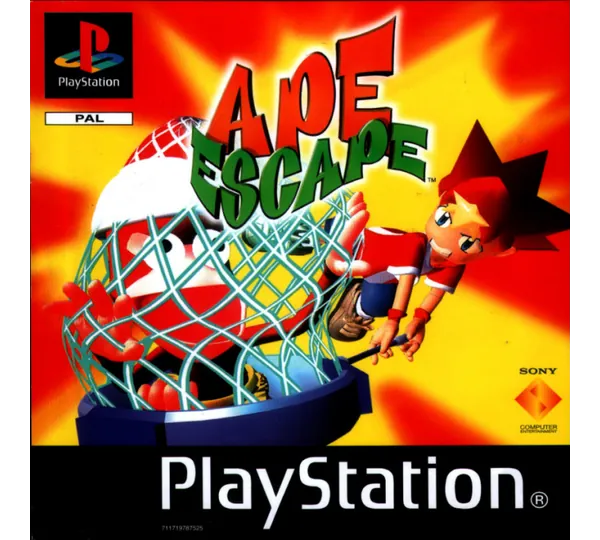

System: Sony PlayStation
Release date: 1999
Post Contents:
ToggleApe Escape PS1 is the game that gave you two thumbsticks, a butterfly net and a very clear instruction to go and catch some monkeys.
Sony released it in June 1999, and it was the first PlayStation game to demand a DualShock or Dual Analog pad. A white-haired monkey called Specter has found a helmet that makes apes clever enough to take over the world, and you play Spike, the lad sent to round them up. It is bright, bonkers and very, very simple to understand. In 2026, does Ape Escape PS1 still go bananas, or has the troop moved on?
Gameplay: Sneak, Swipe, and Net Them
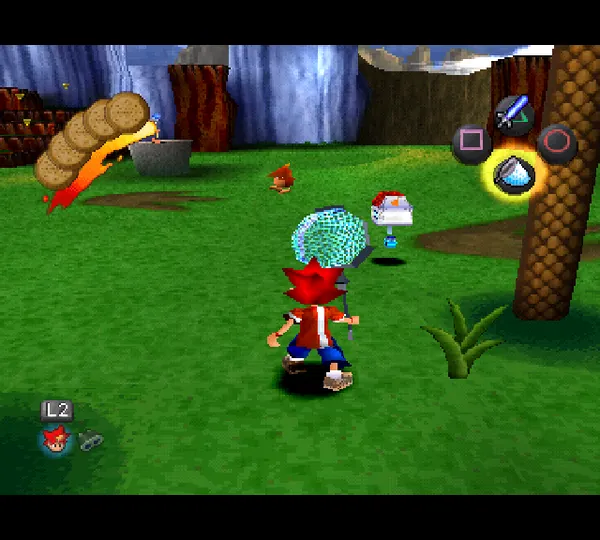
The left stick moves Spike and the right stick works whatever gadget you are holding. You flick the stick to swing the net or aim the slingshot, which is a joy once it clicks. The Time Net is your main tool for catching monkeys, and you will use it a lot. It feels clumsy for the first ten minutes and then wonderfully natural, like you were born holding a net.
The idea is to find every monkey in each level. On your first run you need to catch a set number to move on, and completed levels can be revisited with the right gadgets so you can catch the stragglers. Along the way you pick up gadgets such as the Stun Club, the Slingshot, the Sky Flyer, a radio-controlled car and a monkey radar, and each one changes how you play a level. There are also three minigames at the hub, unlocked with Specter Tokens.
The Last Monkey? Catching most of them is easy. Finding the last cheeky chap hiding in a corner of a big level is a different matter, and the right stick can be fiddly when you are trying to be precise in tight spaces. I spent more than one evening circling a room looking for a single monkey. Bring the monkey radar and some patience.
Graphics: Polygons with a Grin
For 1999 this is a bright and colourful game, full of cartoon charm. The levels are chunky and clearly drawn, with easy-to-read platforms and playful touches, and the monkeys have plenty of character, which makes catching them a pleasure rather than a chore.
Played now, the polygons are blocky and the textures are plain, and the camera can get in the way in tight spots. It still looks cheerful, though, and the clean art style keeps it readable. It has the sort of charm that does not date as badly as realism would have.
Sound: Monkey Business
The music is jaunty, bouncy and a bit silly, in keeping with the tone of the game. The tunes shift to suit each level and they have a playfulness that makes a long hunt more bearable.
The effects are great fun, with monkeys that squeal and chatter and a net that makes a satisfying noise when it connects. Some of the noises can be a bit shrill after a long evening, so I turned the telly down now and then. It fits the daft mood, though.
Replayability: One More Monkey
There is a lot of room to come back to. Revisiting a level with a new gadget to find the monkeys you missed is the heart of it, and the minigames and the Specter Tokens give you something extra to chase. It rewards curiosity and a bit of stubbornness.
It is a single-player game, and it is happiest when you play it in short bursts. If you enjoy collecting and exploring, it will keep you busy for a good while. If you want a quick blast, you might lose patience with the hunting.
The Retro Looney Verdict
Ape Escape PS1 is a fresh, funny and wonderfully inventive platformer that makes brilliant use of the two sticks. The gadgets are fun, the levels are playful and catching a monkey never stops being satisfying.
Yes, the Last Monkey is real, and a fiddly stick in a tight spot can try your patience. None of that changes the fact that this is a joy from start to finish. Grab your net, find your last monkey and see if you can keep your cool.
Don’t forget to check out my other PlayStation Reviews!

Media