
System: Sinclair ZX Spectrum
Release date: 1985
Launch into the vast, lonely reaches of space with Elite on the ZX Spectrum, the 1985 science fiction landmark from Acornsoft that redefined what home computer games could be. Designed by David Braben and Ian Bell, Elite did not just offer levels or a fixed adventure, it offered an entire galaxy. Trading, combat, piracy, exploration, and ambition unfolded across thousands of star systems, all powered by mathematics, imagination, and stark wireframe graphics.
At a time when most games were single-screen platformers or straightforward arcade conversions, Elite felt like a message from the future. Even now, it carries the weight of something genuinely transformative.
Gameplay: Trade, Fight, and Find Your Own Way
Elite drops you into the cockpit of a Cobra Mk III with little more than a pulse laser, a fragile hull, and a head full of ambition. There are no tutorials, no objectives, and no kind words. From the opening moments, the game makes it clear that survival is your responsibility.
You are free to choose your path. You can trade legal goods between systems, dabble in contraband, hunt pirates for bounty vouchers, become an outlaw yourself, or simply drift through the galaxy upgrading your ship piece by piece. Progress is slow and entirely self-directed, driven by risk, planning, and careful decision making.
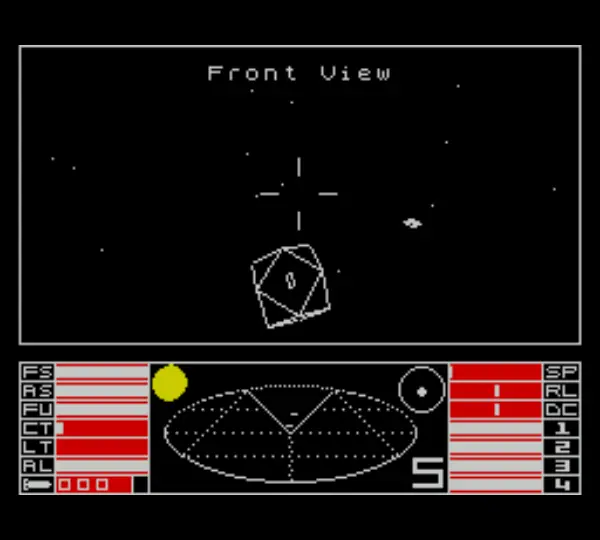
Combat is tense and technical. Viewed entirely from the cockpit across multiple wireframe perspectives, dogfights depend on mastering pitch, roll, speed, and spatial awareness. Enemies attack from all angles, forcing you to manoeuvre rather than simply fire. Manual docking with space stations is infamous, demanding delicate thrust control and precise alignment. Get it wrong and your ship explodes spectacularly.
Trading provides the economic backbone. Each system has an economy shaped by its government and industrial level. Buy low, sell high, and protect your cargo, because pirates will happily ambush you at the worst possible moment. One mistake can undo hours of careful progress.
The deep vacuum? Elite offers almost no guidance at all. New players are thrown into a hostile universe with minimal information, clunky controls by modern standards, and an interface that takes time to decode. Early progress can feel painfully slow, and repeated deaths can be demoralising when your entire save vanishes in a flash. Stick with it though, and that unforgiving start becomes part of the magic. Every success feels earned, and every upgrade marks genuine progress rather than scripted reward.
Graphics: Wireframe Worlds with Infinite Scale
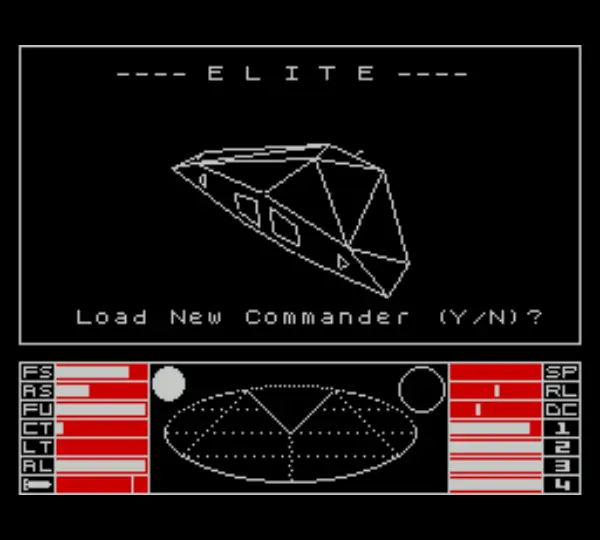
Visually, Elite is instantly recognisable. Its wireframe ships and rotating space stations were a technical marvel on the ZX Spectrum. Rather than sprites or tiles, the galaxy is built from clean vector outlines, allowing fully three-dimensional objects to exist smoothly on hardware never designed for it.
Enemy ships are abstract but readable, each with a distinctive silhouette that conveys threat. Space stations rotate slowly, heightening tension during docking runs. Planets loom as distant geometric orbs, suggesting scale far beyond the screen.
The cockpit overlay is dense but functional. Radar, speed, weapon status, and targeting information surround the main viewport, reinforcing the illusion that you are piloting a machine rather than controlling a character. It may look sparse today, but the design remains effective.
Sound: Sparse Audio, Heavy Atmosphere
Sound in Elite is minimal and deliberate. The Spectrum version relies on beeps and tones rather than music, marking laser fire, impacts, alerts, and hyperspace jumps with sharp audio cues.
This restraint enhances the atmosphere. The silence between encounters makes space feel vast and dangerous, while sudden bursts of sound during combat spike tension instantly. Over time, the minimalist audio becomes inseparable from the experience.
Replayability: A Universe Without an Ending
Replayability is effectively limitless. With thousands of procedurally generated systems, no two journeys play out the same. One run may focus on cautious trading, another on bounty hunting, another on outright criminal behaviour.
There is no final victory screen. Achievement comes through mastery, earning combat rankings, upgrading your ship, and surviving longer each time. Death is permanent, wiping progress entirely, but this only reinforces the value of skill and discipline. Even decades later, Elite invites players back not to complete it, but to inhabit it again.
The Retro Looney Verdict
Elite on the ZX Spectrum is not merely a classic, it is a foundation stone of modern game design. Its ambition, freedom, and technical daring remain astonishing even in 2025. The wireframe visuals and brutal learning curve may challenge modern appetites, but the sense of scale and autonomy it offers is unmatched for its era. Elite did not copy arcade games, it ignored them completely and built its own universe instead. A bold, uncompromising masterpiece that still commands respect across the stars.