
System: Sega Saturn
Release date: 1995
Post Contents:
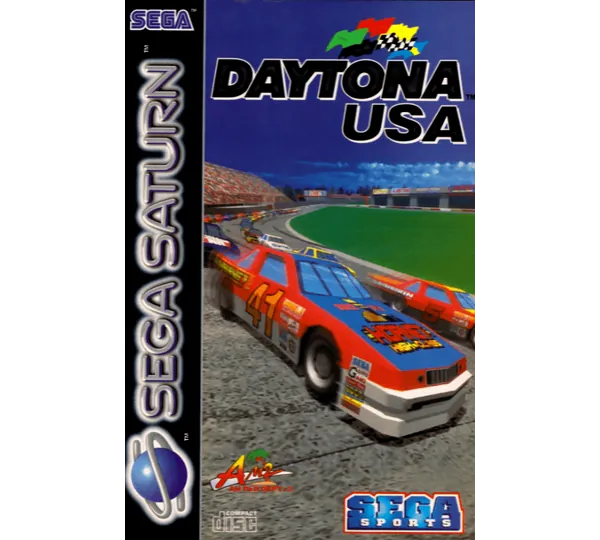
ToggleDaytona USA Saturn is the game that tried to squeeze an entire arcade cabinet, a forty-car stock car pile-up and a rock anthem through the slot of a grey plastic box.
Sega’s AM2 team brought its arcade smash home in 1995, in time for the Saturn’s launch in the west, and the job was never going to be simple. You drive the Hornet, a stock car in a very loud paint job, starting at the back of the grid and clawing past rivals while the checkpoint clock ticks down. Everybody wanted the arcade, and everybody got what the Saturn could manage. In 2026, does Daytona USA Saturn still take the high banking flat out, or has it been left in the pits?
Gameplay: Draft, Slide, and Hold On
The handling is the star, and it is lovely. You pile into a corner, back off just enough, let the Hornet slide round the bend and floor it again on the exit, and there is a satisfying rhythm to the whole thing. Pass a checkpoint and you earn more time, miss your braking point and you slam into the wall or a rival, and a decent run means chasing a field of up to forty cars from the very back of the grid. The three courses start gently on Three Seven Speedway, move on to Dinosaur Canyon, and finish on the twisty Seaside Street Galaxy.
The Saturn version adds a few things of its own. The Saturn mode removes the timer and unlocks more cars to choose from, while the Grand Prix and Endurance modes make you take pit stops, and race damage starts to hurt how the car behaves. You can switch between four camera views and glance behind you, and every course has its own song. That makes it a proper racing game rather than a cabinet in your living room. It is a shame there is no two-player mode at all.
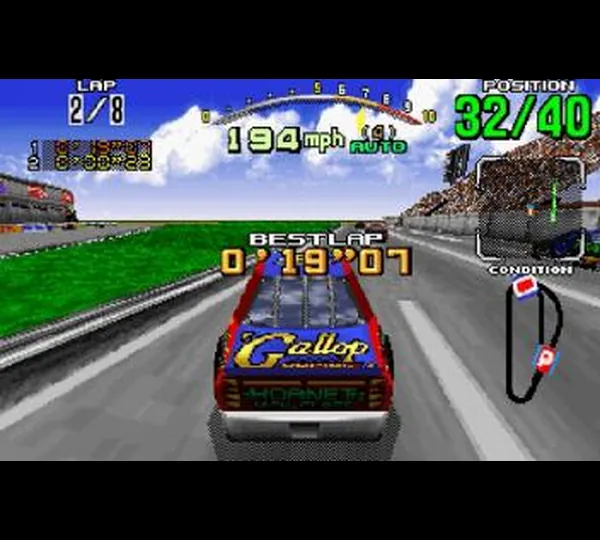
The Pop-Up Wall? The trouble is that the Saturn cannot draw the arcade’s distances, so the scenery arrives late. Walls, barriers and whole stretches of track pop into view just in front of the bonnet, and on the tighter bends you are turning blind until the corner has rendered itself. The frame rate struggles too, wobbling at about twenty frames a second, and it drops further when the field bunches. It stays playable, but it never matches the smoothness that the cabinet gave you. Take the first corner on instinct and let the game catch up.
Graphics: Polygons on a Tight Budget
In 1995 this was a big deal. Daytona USA was a showcase for texture-mapped 3D polygons wrapped around cars and courses, and on the Saturn it showed bright, solid grandstands, banked circuits and a convincing sense of the car sliding about. Putting it on a home console at all was a technical feat, and it looked like nothing else on the shelf that summer.
Today it looks like a brave port rather than the arcade. The textures are simplified and low resolution, the pop-up is hard to ignore, and the frame rate keeps reminding you that this is a conversion. I would call it chunky, colourful and noticeably compromised, with the blue skies doing a lot of heavy lifting.
Sound: Singing Round the Bend
The soundtrack is a joy, and I have no shame about that. Takenobu Mitsuyoshi wrote a different song for each course, and the Saturn remix keeps the cheerful, over-the-top energy that made it famous. ‘Let’s Go Away’ is the Daytona theme, and when it kicks in at the start line you are grinning before you have even changed gear.
The effects are the usual roar of engines, squealing tyres and crunching crashes, and they do the job without stealing the spotlight. The vocals can be cheesy, I will admit, but it is a gloriously daft kind of cheese. It is some of the most memorable music in any racing game I have played, and well worth turning the volume up for.
Replayability: Another Lap of the Speedway
The three courses are shorter than you would like, but there is plenty to chase. The Saturn mode gives you extra cars, Grand Prix and Endurance make you plan your pit stops and manage the damage, and you can always go back and improve your position on the harder circuits. Trying to win from the back of a forty-car pack never gets old.
The catch is that three tracks do not last forever, and the missing multiplayer is a loss for a game made to race against friends. If you enjoy racing for its own sake, you will get a good few evenings out of it. If you want a sprawling list of circuits, look elsewhere.
The Retro Looney Verdict
Daytona USA Saturn is fast, loud and slippery, a game with some of the best handling in any 1995 racer and a soundtrack that sticks in the head. The Hornet is a joy to throw round a bend, and the sense of speed on a clear stretch is the best advert for the Saturn’s early days.
Yes, the pop-up wall is real, and the frame rate never quite keeps up with the driving. The three tracks and the missing two-player mode do not help either. None of that stops it being a thrill. Hold your line, sing along, and keep your foot flat on the floor.
Don’t forget to check out my other Saturn Reviews!

Media