
System: Sinclair ZX Spectrum
Release date: 1987
Post Contents:
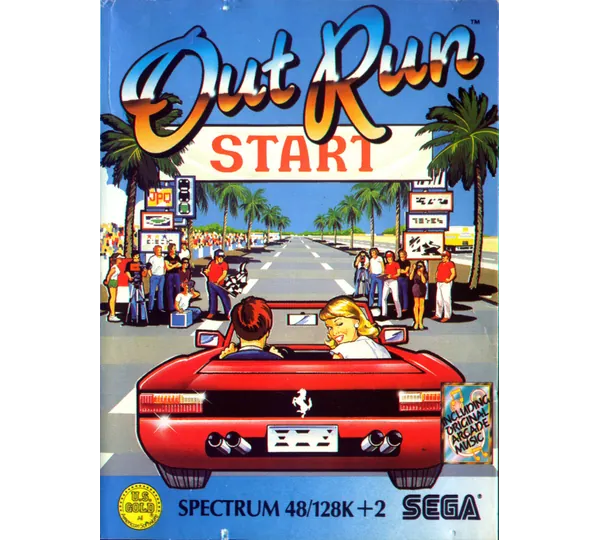
ToggleOut Run Spectrum is the game that tried to fit a Ferrari, a sun-soaked coastline and an entire arcade cabinet onto a cassette tape.
US Gold brought Sega’s driving classic home to the Spectrum in December 1987, with Probe Software doing the squeezing. You sit behind a Testarossa convertible, weave through traffic and race a countdown timer down a road that forks towards different destinations. The arcade original was a sunset on wheels, and the rubber-keyed box under the telly was never going to match it. So what did we actually get? In 2026, does Out Run Spectrum still cruise with the roof down, or has it been stuck behind a lorry since 1987?
Gameplay: Steer, Dodge, and Beat the Clock
The idea survives the journey. You hold the accelerator down, steer a Testarossa along a road that curves, climbs over crests and dips out of sight, and dodge the traffic that wanders into your lane. The clock is the real enemy: every checkpoint adds a few seconds, and running out of them ends the trip. The cursor keys, a Kempston joystick or an Interface 2 pad all do the steering.
The cleverest bit is the fork at the end of each stage, where you pick which way the road goes and so which stretch of scenery you head for next. That little decision turns a straight race into a route you plan, and it is the part of the arcade original that this version keeps intact. Rival cars and scenery are all there too, so it still feels like Out Run, viewed through a frosted window.
The Slow Lane? The trouble is that Out Run is about speed and this version has very little of it. The busier the screen gets, the more the frame rate sags, and on the crowded stretches you are crawling along at a handful of frames a second. Steering at that pace is guesswork, the collisions can be unkind, and the tape loads in chunks, which stops the fun dead between sections. Play the 128K version or the Spectrum +3 disk release if you can, and bring a cuppa and some patience.
Graphics: A Brave Attempt in Blocks
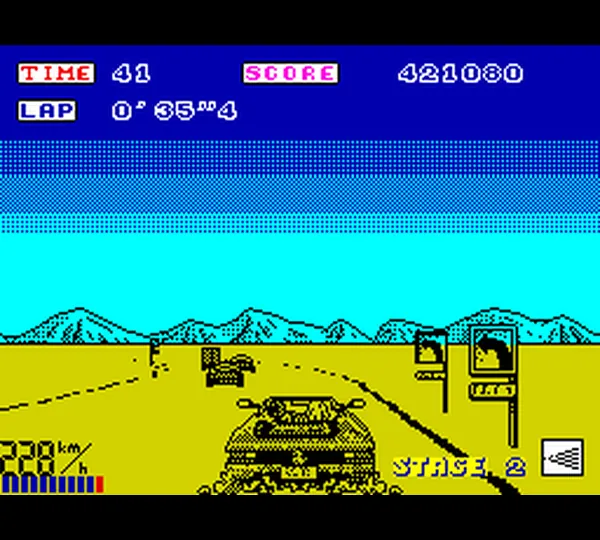
Probe tried to cram in everything. The road bends and rolls, the roadside objects grow as you approach, palm trees line the coast, and the traffic is all present and correct. Putting that much detail on a Spectrum screen was a brave thing to attempt, and it is exactly why the game slows down so badly: the machine simply cannot move that much scenery at the speed the game needs.
Today it looks rough rather than charming. The colour comes in big chunky blocks, with yellow ground and a flat cyan sky, and the Testarossa on screen is a dark blocky shape rather than the glossy red car on the box. It is recognisably Out Run, but I would call it a good idea drawn with too few crayons.
Sound: The Tune Saves the Day
This is where the Spectrum redeems itself. On a 128K machine the AY sound chip plays a proper version of the famous arcade music, with a bouncy beat that makes the whole business feel like a holiday drive. It is a lovely little arrangement by Jas C. Brooke, and for a lot of players the music is the strongest reason to load it up.
The catch is that it only really shines on the 128K. Fire up a 48K Spectrum and you are left largely with silence and the clatter of your own fingers. Even on the bigger machine, when the screen fills with scenery some of the notes drop out, which is a shame, but the tune still wins the section.
Replayability: One More Run Down the Coast
The forking roads are the hook. Each stage lets you choose a direction, so you can come back, take another route and see different scenery, and trying to beat the clock with a cleaner run is a perfectly good reason to have another go. A high score and a better route will keep you busy for a few evenings.
But the sluggish speed and the long loading make it harder to love for long, and the multiload on tape is a test of nerves. If you never saw the arcade original, you will enjoy it a lot more than someone who remembers the real thing. It suits patient Speccy fans far better than anyone expecting a thrill ride.
The Retro Looney Verdict
Out Run Spectrum is ambitious, pleasantly noisy on a 128K, and nowhere near as quick as a game about speed needs to be. The forking road, the ticking clock and the music are all there, and they make a decent game, but the frame rate holds it firmly in second gear.
Yes, the slow lane is a genuine problem, and the blocky graphics will not win over anyone who knows the arcade. That makes this a mixed bag rather than a joyride. If you have the patience, though, it is still a fascinating look at how far the Spectrum could be pushed. Pick a fork, watch the clock, and forgive the frame rate.
Don’t forget to check out my other ZX Spectrum Reviews!

Media