System: Sega Mega Drive
Release date: 1994
Post Contents:
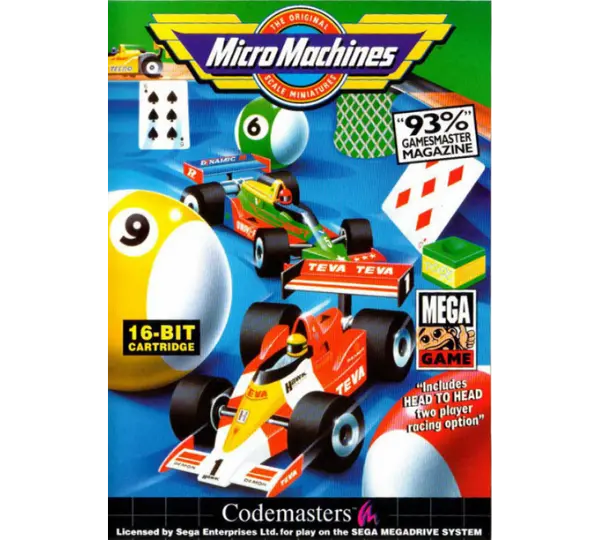
ToggleMicro Machines on the Mega Drive is the game that proved the best racing title on a 16-bit console didn’t need to feature full-size cars, realistic physics, or a single straight piece of road.
This Micro Machines title took Codemasters’ brilliant top-down racer and gave it the Mega Drive treatment – tiny vehicles tearing across kitchen tables, garden paths, snooker tables, and bathroom floors in some of the most creative racing environments ever put in a home console game. The concept is simple, the execution is brilliant, and the multiplayer will ruin friendships in the most enjoyable way possible. In 2026, does this Micro Machines Mega Drive miniature masterpiece still race ahead of the competition, or has it finally been swept off the table?
Gameplay: Tiny Cars, Massive Fun
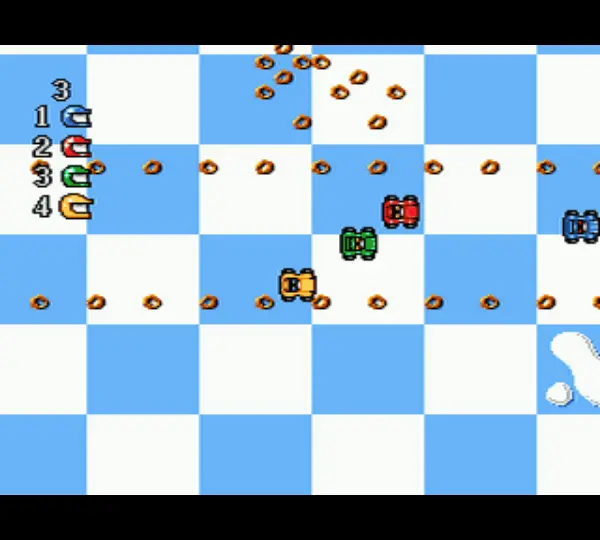
The game drops you into a top-down racing experience across a wonderfully varied collection of everyday environments reimagined as racing circuits. Kitchen worktops with cereal boxes as obstacles, garden paths edged with grass, snooker tables where the pockets are instant death, bathroom floors with soap bars to slide around – each venue is immediately readable and consistently inventive.
The vehicle variety is equally impressive. Formula One cars, monster trucks, hovercrafts, speedboats, tanks, and helicopters all handle differently and suit different track surfaces, giving the game real variety across its roster of events. The handling model has a satisfying top-down momentum to it – not quite arcadey enough to feel weightless, not quite realistic enough to become frustrating, sitting in exactly the right place between the two.
The defining mechanic is the elimination system – fall too far behind the leader and you lose a life, keeping the field bunched and the tension high throughout every race. It’s a brilliant design choice that ensures no race is ever truly over until the last corner.
The Flea Market? Micro Machines on the Mega Drive is not a deep single-player experience. The AI is competent but predictable once you’ve learned the tracks, and solo play lacks the chaos and unpredictability that makes the multiplayer so compelling. The track count, while varied, eventually becomes familiar enough that experienced players will be navigating on muscle memory rather than genuine engagement. Some of the vehicle types handle awkwardly enough in tight environments to produce deaths that feel cheap rather than earned, and the difficulty in the later championship rounds spikes without much warning.
Graphics: Everyday Environments, Extraordinary Detail
The visual design is one of Micro Machines’ great achievements and it holds up beautifully. The environments are packed with incidental detail that sells the scale completely – breakfast bowls, pencils, coins, and everyday objects rendered large enough to function as track furniture while simultaneously communicating exactly where you are. A kitchen table looks like a kitchen table. A snooker table looks like a snooker table. The conceptual clarity is total.
Vehicle sprites are clean and distinct, the scrolling is smooth throughout, and the colour palette is bright and immediately readable even when several vehicles are bunched together on a tight corner. Visually purposeful and charming in equal measure.
Sound: Cheerful Chaos on Four Wheels
The audio package is cheerful, energetic, and perfectly pitched for the game’s tone. Engine sounds shift convincingly between vehicle types – the Formula One car sounds distinct from the hovercraft, which sounds distinct from the tank – and the collision effects land with satisfying crunch when vehicles meet at speed.
The music is upbeat without becoming intrusive, maintaining energy across longer sessions without the kind of repetitive loop that wears out its welcome. Sound effects from the environment – water splashing, surfaces changing underfoot – add texture and reinforce the sense of racing through real domestic spaces at improbable scale.
Replayability: One More Race, Always
Micro Machines on the Mega Drive earns its replay value almost entirely through its multiplayer, which remains one of the finest couch gaming experiences on the platform. Up to eight players can participate using just two controllers through the simultaneous head-to-head system, which turns ordinary Mega Drive sessions into proper events – everyone crowded around the screen, shouting at the screen, accusing each other of deliberate interference that was absolutely deliberate.
The championship structure gives solo players a progression goal, and the vehicle and track variety ensure the experience doesn’t collapse into repetition quickly. But this is fundamentally a game designed to be played with other people, and it delivers that experience as well as anything on the system.
The Retro Looney Verdict
Micro Machines on the Mega Drive is one of those games that exists in a category of its own – immediately accessible, endlessly entertaining in company, and built on a concept so elegantly simple that it’s impossible to imagine anyone not understanding it within thirty seconds of picking up the controller.
The solo experience has limits and the AI won’t trouble experienced players for long. None of that matters once you’ve got friends on the sofa and everyone’s arguing about who knocked who off the snooker table. This Micro Machines Mega Drive classic belongs in every collection – not just for the game itself, but for the memories it will absolutely generate. Get it on, grab the controllers, and try not to take the kitchen table corner too wide.
Don’t forget to check out my other Mega Drive Reviews!

Media